
It’s not about a dry scalp. The real culprit is far more specific to where you live.
If you live in Chennai, you know what April and May feel like. The heat is relentless. The humidity follows you everywhere, from morning to night. What many people don’t realise, however, is that this climate shapes the health of your scalp.
Dandruff is widely misunderstood. Most people assume a dry scalp causes it. As a result, they reach for moisturising shampoos. In Chennai, that assumption leads you in the wrong direction entirely.
In tropical climates, excess moisture, oil, and fungal overgrowth drive dandruff not dryness.
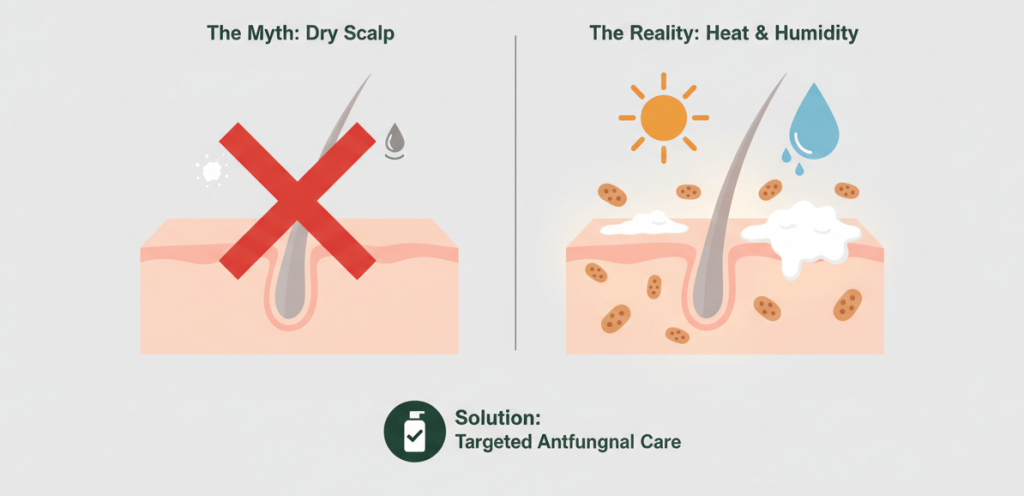
How humidity and heat team up against your scalp
Chennai’s humidity means your scalp rarely gets a chance to breathe. Sweat builds up fast. It does so whether you’re commuting, working, or simply going about your day. Consequently, a persistently moist environment forms on your skin.
This moisture promotes the overgrowth of Malassezia. It is a fungus that lives naturally on every human scalp. Under normal conditions, it causes no harm. However, when the scalp stays warm and damp for long periods, Malassezia multiplies too fast. It then irritates the skin. The result is flaking, itching, and persistent sensitivity.
The role of sebum
The heat also increases how fast your scalp produces sebum. Sebum is your skin’s natural oil. Malassezia feeds specifically on sebum lipids. Therefore, more oil means more fuel for fungal overgrowth.
In addition, humidity and sweat combine with this excess oil. Together, they also trap dead skin cells. As a result, sticky flakes form that cling to the scalp instead of falling away.
Unlike the powdery flaking of a dry scalp, these flakes are heavy and hard to shift.
The four factors working against you in Chennai
| Factor | Effect on scalp |
| Constant humidity | Keeps the scalp moist, creating ideal conditions for fungal growth |
| Excess heat | Drives up oil production, which feeds Malassezia directly |
| Urban pollution | Dust mixes with sweat, clogging follicles and inflaming skin |
| Disrupted barrier | Repeated irritation weakens the scalp’s natural defences over time |
Why washing your hair more often backfires
When your scalp feels sweaty and oily, washing it daily seems logical. It does offer short-term relief. However, daily shampooing with a harsh formula often makes the problem worse.
Frequent washing strips away the scalp’s protective oils. In response, the sebaceous glands produce even more oil. This triggers a cycle of over-cleansing and over-production. The scalp then becomes reactive. As a result, dandruff returns faster each time.
| Scalp becomes oily and sweaty |
| ↓ |
| Hair is washed daily with a stripping shampoo |
| ↓ |
| Natural oils are removed |
| ↓ |
| Scalp overproduces oil to compensate |
| ↓ |
| Dandruff returns — often worse than before |
Why standard shampoos don’t resolve it
Most shampoos cleanse the scalp. They remove visible flakes. They also leave the scalp feeling fresh. Yet they do not address the root cause. That cause has three parts: fungal imbalance, excess sebum, and a weakened scalp barrier.
Without targeting all three, relief is always short-lived. This is why so many people cycle through products without lasting improvement.
What effective treatment actually requires
First, treatment must target the antifungal component. Ingredients such as zinc pyrithione, ketoconazole, or selenium sulphide all reduce Malassezia overgrowth. Their evidence base is strong.
Additionally, the right approach balances sebum levels. It also supports the scalp barrier rather than degrading it. Both steps are equally important.
Furthermore, washing frequency matters. For most people, every two to three days works better than daily washing. This lets the scalp regulate itself. It also prevents compensatory oil production.
Persistent dandruff in Chennai is rarely about poor hygiene. Instead, it is the predictable result of a hot, humid environment. Understanding that distinction is the first step toward treating it properly rather than managing symptoms indefinitely.
For a long-term solution, Maynee Cosmetology Clinic, Porur provides specialized clinical care. Furthermore, they focus on the root causes of summer dandruff, such as fungal overgrowth and sebum imbalance. Consequently, patients receive a targeted plan that goes beyond surface-level cleaning. Additionally, their expertise in local environmental factors ensures that your scalp stays healthy despite the heat. Therefore, professional consultation at Maynee offers a more sustainable path to a flake-free scalp.
Frequently Asked Questions
In Chennai, the “flare-up” isn’t caused by dryness, but by the intense humidity and heat. High temperatures increase your scalp’s sebum (oil) production, while humidity prevents sweat from evaporating. This creates a warm, damp “greenhouse” on your scalp the perfect breeding ground for Malassezia, the fungus responsible for dandruff.
It’s easy to tell them apart by looking at the flakes:
> Dry Scalp: Tiny, white, powdery flakes that fall easily. Your scalp feels tight.
> Summer Dandruff: Larger, yellowish, oily, or “sticky” flakes that often cling to the hair or scalp. Your scalp usually feels greasy or itchy.
Sweat itself doesn’t cause dandruff, but it is a major catalyst. Sweat is composed of water and salts; when the water evaporates, the leftover salts can irritate the skin. More importantly, the moisture left behind keeps the scalp damp, which allows dandruff-causing fungi to multiply much faster than they would on a dry scalp.
In a humid climate like Chennai, heavy oiling can actually make dandruff worse. The fungus Malassezia feeds on lipids (oils). By adding more oil to an already greasy scalp, you are essentially feeding the dandruff. If you use oil, apply it only to the hair ends, or ensure you wash it off thoroughly within 30 minutes.
While it’s tempting, daily washing with harsh shampoos often backfires. It strips the scalp of all natural moisture, causing your oil glands to go into “overdrive” to compensate. This leads to even more oil and more dandruff. Aim for every 2 to 3 days using a formula that balances the scalp rather than just stripping it.
Yes. Hard water contains high levels of minerals like calcium and magnesium. These minerals can react with your shampoo to leave a “scum” or film on your scalp. This buildup clogs pores and traps sweat and fungus, making it much harder to clear dandruff and often leading to increased scalp irritation.
Dandruff doesn’t directly kill hair follicles, but the inflammation and itching it causes can lead to hair fall. Frequent scratching can damage the hair shaft and weaken the roots. Furthermore, a fungal overgrowth creates an unhealthy environment for hair to grow, which can cause temporary thinning.
Most standard shampoos only wash away the visible flakes without addressing the fungal imbalance or the scalp barrier. If the shampoo is too harsh, it damages your scalp’s natural defenses, making it easier for the fungus to return the moment you stop using the product.
For the specific conditions in Chennai, look for antifungals and sebum-regulators:
> Ketoconazole or Zinc Pyrithione: To reduce fungal growth.
> Salicylic Acid: To help break down and wash away sticky, oily flakes.
> Selenium Sulphide: For more persistent or severe flaking.
Yes, but application is key. Never apply conditioner directly to your scalp, as the heavy emollients can clog follicles and worsen oiliness. Apply it only from the mid-lengths to the ends of your hair to keep your strands healthy without fueling the dandruff on your scalp.