Have you tried serums, home remedies, or one round of a single therapy with little to show for it? You’re not alone. Hair thinning has more than one cause. It could be genetic pattern loss, stress-related shedding, or damage from your environment. Often, it’s all three at once. That’s why a single treatment tends to stall after a few sessions. It’s also why clinics now plan combination protocols instead of relying on just one therapy.
This isn’t about piling on more treatments for the sake of it. Each therapy covered here — microneedling, GFC/PRP, and exosome therapy — targets a different cause of weak follicles. Alone, each one leaves a gap. Together, in the right order and at the right intervals, they cover each other’s blind spots.
Why one treatment on its own tends to plateau
The three causes behind hair thinning
Androgenetic alopecia (pattern hair loss) isn’t caused by one thing. Three processes usually run at the same time, and they reinforce each other:
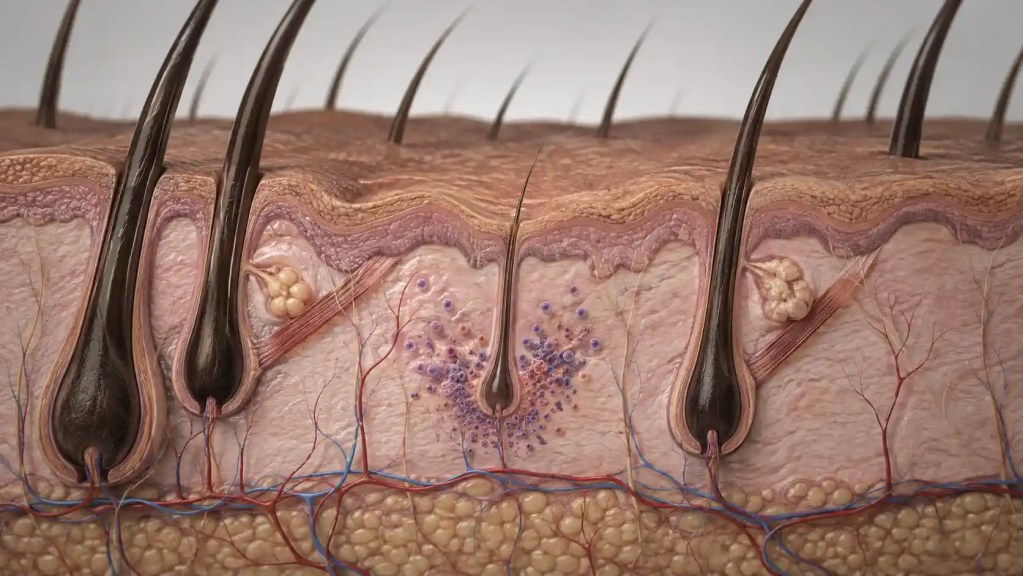
- DHT binds to receptors in follicles that are genetically sensitive to it. Over each growth cycle, it shrinks these follicles a little more — a process called miniaturisation. Over years, the hair gets finer. Growth cycles get shorter. Eventually, some follicles stop producing visible hair.
- Reduced scalp blood flow starves the follicle of the oxygen and nutrients it needs for a normal growth cycle. This doesn’t happen separately from DHT — it makes the DHT effect worse.
- Low-grade inflammation around the follicle often stays below the level you’d notice as redness or irritation. But it still wears down the stem cells that regrow the follicle at the start of each new cycle.
In most people, these three causes don’t act alone — they act together. That’s the core problem with a single therapy. Each one addresses just one cause, not all three. For more on how DHT, genetics, and follicle shrinkage interact, see this overview of androgenetic alopecia from the NCBI Bookshelf.
Why a single therapy can’t cover all three
- PRP or GFC alone delivers growth factors to the scalp. But it still depends on how well your follicles can respond. If circulation is poor, or if buildup and inflammation block the pathway, much of that signal never reaches its target.
- Microneedling alone boosts local blood flow. It also triggers the skin’s own healing response. But it adds no extra growth factors of its own. It opens the door for repair, without supplying the raw material.
- Exosome therapy alone carries strong cell-signalling cargo. This can wake up dormant stem cells. But it needs a way past the scalp’s surface to reach the follicle in real concentration. Applied to intact skin, most of it never gets there.
This is why results often plateau around session three or four when only one therapy is used. Combine them, and each one covers a gap the others leave open — instead of three treatments working in isolation.
How a combined protocol works, step by step
1. Microneedling opens the door
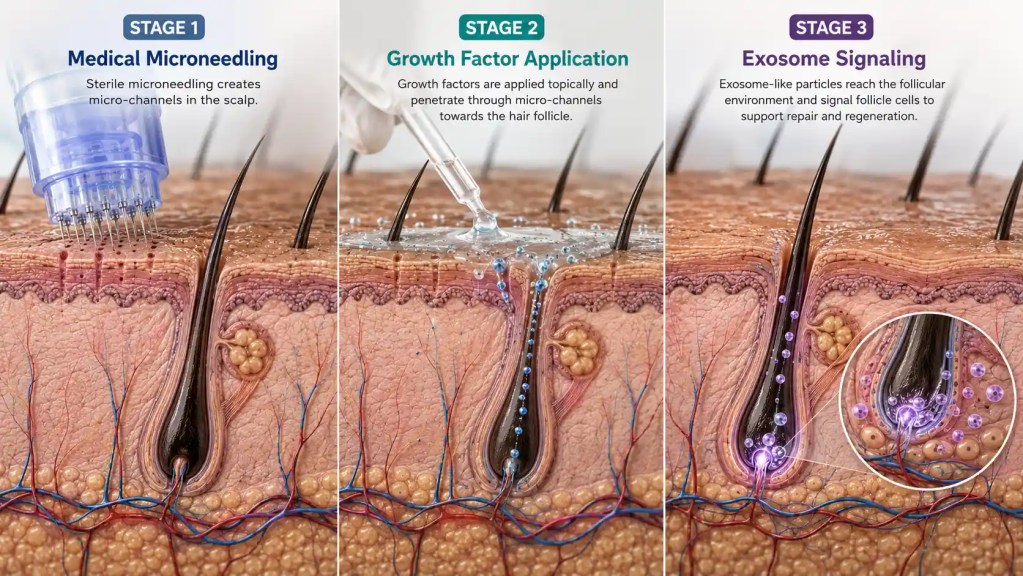
Microneedling uses fine medical-grade needles. These make controlled micro-punctures across the scalp. This does two things. First, it triggers the body’s own healing response. That response releases growth factors and wakes up hair follicle stem cells. Second, it opens temporary micro-channels in the skin’s outer layer. Whatever we apply next — GFC, PRP, or exosomes — can then reach deep into the follicle. It doesn’t just sit on the surface.
Needle depth matters here. For example, if it’s too shallow, the channels don’t open enough for real absorption. Too deep, and the risk of scarring or extra downtime rises without adding much benefit. That’s why we set depth for each patient instead of using one fixed setting for everyone who walks in.
2. GFC or PRP feeds the follicle
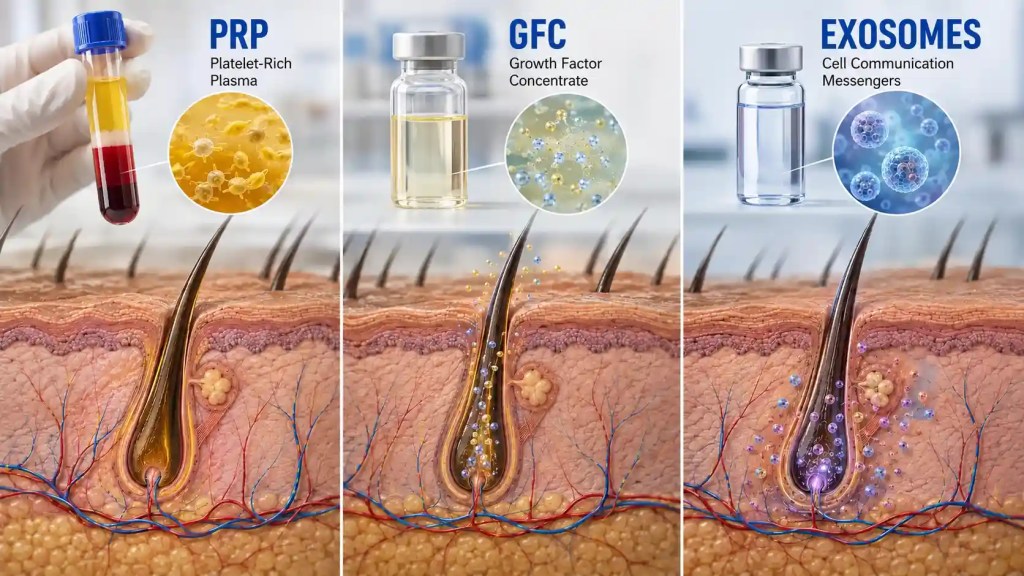
Traditional PRP (Platelet-Rich Plasma) starts with a small blood draw. A centrifuge separates out the platelets. We then apply that platelet-rich fraction to the scalp. It’s an established, well-studied approach. However, it still contains some red and white blood cells along with the platelets. So its strength can vary from person to person.
GFC (Growth Factor Concentrate) starts with the same blood. We just process it further. This isolates a purer, cell-free dose of specific growth factors: PDGF, VEGF, EGF, and IGF-1. Removing the red and white blood cells gives a more standardised result each time. We use this fraction to grow new blood vessels around the follicle. This fixes the nutrient-supply problem above. It also signals miniaturised follicles to stay in their growth phase longer.
3. Exosomes carry the signal deeper
Exosomes are tiny particles that cells release. They carry microRNA and proteins. These tell other cells what to do next. In trichology, exosome preparations usually come from cultured stem cells. Common sources include mesenchymal stem cells, and in some formulations, plant cells. They are not synthetic — they aren’t built from scratch in a lab.
We apply exosomes right after microneedling, while the scalp’s channels are still open. They do two jobs: wake up dormant stem cells, and calm the low-grade inflammation covered above. A 2025 scoping review of exosome delivery methods for hair loss found that microneedling was the best way to deliver exosomes. So clinics pair the two together.
PRP vs. GFC vs. exosomes, side by side
| PRP | GFC | Exosome therapy | |
| Source | Patient’s own blood | Patient’s own blood, further processed | Cultured stem-cell or plant-derived preparations |
| What’s in it | Platelets plus some red and white blood cells | Concentrated, cell-free growth factors | Concentrated signalling particles (microRNA, proteins) |
| Main job | General tissue repair and baseline growth support | Nourishing and thickening existing follicles | Deep cellular signalling and follicle reactivation |
| Consistency | Varies with the patient’s own blood profile | More standardised output | Standardised, lab-prepared concentration |
| Typically paired with | Microneedling | Microneedling | Microneedling (applied last, after channels are open) |
Why Chennai’s climate makes this worse — including in Ambattur
Environment plays a bigger role in scalp health than most people realise. It’s a big reason why a treatment that works well in a different climate can underperform here. In particular, residents of industrial areas like Ambattur face a few specific, compounding stressors:

- Hard/borewell water. Ground and borewell water here carries high mineral content. Repeated washes leave a crust-like residue on the scalp. This clogs the small opening each follicle grows out of and disrupts the scalp’s natural pH balance. Over time, this speeds up breakage and dryness.
- Humidity and dust. Humidity, plus pollution common in industrial zones, tends to raise sebum production. It also encourages dandruff-causing fungal growth. And it keeps the scalp mildly inflamed — the same low-grade inflammation covered earlier.
- Long commutes. Daily exposure to traffic and industrial routes raises cortisol and oxidative stress. This can trigger sudden, diffuse shedding, known as telogen effluvium, on top of any pattern loss you already have.
In these conditions, a scalp serum at home usually isn’t enough on its own. It’s fighting an environment that keeps bringing back the same stressors. A layered clinical protocol tackles both sides at once. It clears existing inflammation and mineral buildup, while feeding and reactivating the follicle. That’s a big reason combination approaches hold up better than single treatments in this climate.
Who tends to be a good fit for a combination protocol
Combination protocols aren’t automatically the right starting point for everyone. They tend to make the most sense for people who:
- Already tried one therapy, or a topical-only routine, for several months with results that plateaued or never really started
- Have moderate, established thinning rather than very early, mild shedding that might still respond to simpler measures
- Don’t have an active scalp infection or an uncontrolled bleeding disorder that would rule out microneedling or blood-derived treatments
- Can commit to the full session schedule and the maintenance phase after it, not just one or two sessions
As a result, a trichoscopy assessment always comes first, rather than jumping straight into a protocol. It confirms whether combination therapy is actually warranted, or whether a simpler approach would do the job.
Safety and what a typical timeline looks like
Combining therapies always starts with a proper assessment. We set microneedling depth for each patient’s scalp rather than using one fixed setting for everyone. And we perform every session under clean, controlled conditions to avoid scarring or secondary infection.
A realistic protocol generally looks like this:
- Initial visit — scalp trichoscopy to check hair density, follicle health, and inflammation levels before recommending anything at all.
- Sessions 1–3 — the combined microneedling, GFC/PRP, and exosome protocol. We space these roughly 3–4 weeks apart so each session lines up with the scalp’s natural repair cycle.
- From month 6 onward — maintenance sessions and progress reviews. These are spaced further apart than the initial course, to hold onto your gains and catch early signs of relapse.
At Maynee Skin, Hair & Slimming Clinic, Ambattur, we always start with a trichoscopy consultation with our hair specialists. We do this before recommending any combination protocol. Not every scalp needs every therapy in the stack. The right mix depends on what’s actually driving your hair loss. A visual scan or a quick chat can’t reliably tell us that on its own.
What to expect during and after
- Downtime is minimal for most people. Expect mild redness or tightness on the scalp, which usually settles within 24 to 48 hours.
- Sessions are spaced 3–4 weeks apart, not back-to-back. This gives the scalp time to complete its own repair cycle between visits.
- Timeline — most people notice less daily shedding after their second session. Visible changes in shaft thickness and density show up later, usually between months three and six. New hair growth is slow. No treatment can rush it.
- Aftercare generally means keeping the scalp clean. Avoid harsh chemical treatments for a short window after each session. Given the water quality issues above, we often add guidance on managing hair and scalp exposure at home between visits.
What affects how many sessions you’ll actually need
No two scalps respond at exactly the same pace. A few factors tend to influence the total number of sessions and how quickly results show up:
- How advanced the thinning is. Early-stage diffuse thinning generally responds faster than areas with long-standing, more complete follicle miniaturisation.
- Age and overall health. Younger, generally healthy follicles tend to respond to growth factor signalling more readily than long-dormant ones.
- Consistency with the schedule. Skipping or delaying sessions blunts the cumulative effect the protocol is built around. Each session is designed to build on the last one.
- Environmental exposure between sessions. Ongoing hard water use or high pollution exposure can work against your in-clinic gains. Because of this, aftercare guidance matters as much as the sessions themselves.
Frequently asked questions
Yes, when trained staff plan and perform it under clean conditions. We adjust microneedling depth and the order of application to your scalp. That’s why a trichoscopy assessment matters before we start.
PRP is platelets separated from a blood draw, and it still contains some red and white blood cells. GFC processes that blood further to isolate a purer, cell-free concentration of specific growth factors. This tends to give a more consistent, repeatable result from session to session.
It can slow progress if we don’t address it alongside treatment. Mineral buildup from borewell or hard water affects the scalp surface on an ongoing basis. That’s why most protocols pair in-clinic sessions with guidance on scalp cleansing and managing water quality at home between visits.
Most protocols run three sessions spaced 3–4 weeks apart, followed by maintenance reviews from around month six. The actual number depends on how advanced the thinning is, your age, and how your scalp responds. That’s why we confirm this after assessment, not upfront.
Anyone considering a combination protocol. It’s the most reliable way to confirm what’s driving the hair loss. It also shows which mix of microneedling, GFC/PRP, and exosomes fits your scalp.
Minimal for most people. Mild redness or scalp tightness is common and usually settles within a day or two. Individual reactions can vary slightly, depending on skin sensitivity and the microneedling depth used.
Often, yes but it depends on what else is in your routine. Raise this during the trichoscopy consultation. That way, we can factor in any products or medications you already use, instead of working against them.
Ready to find out what your scalp actually needs?
A combination protocol only makes sense once you know what’s causing the thinning. Book a trichoscopy consultation with our hair specialists at Maynee Skin, Hair & Slimming Clinic, Ambattur. Get a clear read on your scalp before you decide on a treatment plan.
Call/WhatsApp: +91 93848 38505 | Email: hello@maynee.in | Contact us online Hours: Open 7 days, 10 AM – 8 PM