
Medically reviewed by Dr. Murali K, M.B.B.S., M.S. (General Surgery), M.Ch. (Plastic Surgery) | Last updated: July 2026
Medical reviewer: Dr. Murali K is a plastic surgeon with 15+ years of clinical experience, registered with the Tamil Nadu Medical Council. He reviewed this article for clinical accuracy before publication.
If you’re finding more hair on your pillow than usual, you’ve probably run into “PRP therapy” online. People talk about it a lot on Instagram, in dermatology forums, in clinic brochures. That’s part of the problem, actually, because hair loss treatment is a crowded, heavily marketed space. So a little skepticism is fair. Does PRP actually do anything at the follicle level? Or is it mostly hype with a needle attached?
Below, we walk through what the research says. We also look at what it means in practice for someone getting treated in India.
What PRP actually is
PRP stands for Platelet-Rich Plasma. It’s a non-surgical treatment. It uses concentrated parts of your own blood to try to revive weak hair follicles.

The logic is fairly simple once you break it down. Blood contains red cells, white cells, plasma, and platelets. Platelets are best known for clotting. But they also carry growth factors proteins your body already uses to repair damaged tissue. So PRP simply takes that existing repair mechanism and redirects it at the scalp.
How the procedure works
It’s a three-step process that usually takes 45 to 60 minutes:
- Blood draw. First, we draw a small sample, around 10–20ml, from your arm — the same as a routine blood test.
- Centrifuge spin. Next, a centrifuge spins the sample at high speed and separates the platelet-rich plasma from the red blood cells.
- Injection. Then we inject the concentrated plasma into the thinning areas of the scalp.
The plasma comes from your own blood. So the risk of allergic reaction or immune rejection is very low. You’re not introducing anything foreign into your system.
Does it actually work?
Short answer: yes, with some real caveats. PRP doesn’t create new follicles where none exist. But there’s decent evidence it can slow shedding and thicken existing, weakened hair.
The most careful look at the evidence comes from a 2024 review. It’s by Zhang et al., published in Anais Brasileiros de Dermatologia. It pooled 14 randomized controlled trials covering 431 patients. It found a statistically significant increase in hair density with PRP compared to placebo. However, the authors were upfront that the underlying studies varied a lot in quality. So they’re calling for larger, better-controlled trials, rather than treating the case as closed. A separate, larger meta-analysis from Johns Hopkins (2020) pooled 30 studies and 687 patients. It reached a similar conclusion: PRP beats placebo on hair density and thickness, without serious safety concerns.
For example, a 2025 Vietnamese study offers a closer look at what this feels like in practice. Researchers followed 41 patients through three PRP sessions, four weeks apart. Using Trichoscan imaging, they tracked hair density over time. It rose from 40.76 hairs/cm² at baseline to 66.00 hairs/cm² after the third session. The hair pull test is the standard bedside check for active shedding. In this study, the number of patients with a positive result dropped from 75.6% before treatment to 12.2% after. Worth noting: this was a single-arm study without a placebo group. So it shows what happened to these patients, not a controlled comparison. Still, it lines up with the direction the larger meta-analyses point in.
Here’s the biological explanation behind all this. Growth factors in the platelets, particularly VEGF and PDGF, encourage new blood vessel growth around the hair root (angiogenesis). That, in turn, improves oxygen and nutrient delivery to the follicle. Researchers think this helps nudge dormant follicles (in the resting, or telogen, phase) back into active growth (anagen).
Why Chennai and other Indian cities add extra strain
Genetics still does most of the heavy lifting in pattern hair loss. But local conditions can speed things up. In cities like Chennai, hard water is a big factor. Heavy reliance on groundwater or tanker supply regularly exposes hair to high calcium and magnesium content. Over time, this builds up on the scalp and weakens the hair shaft.
Add in air pollution and humidity, and you get another layer of irritation. Particulate matter binds with scalp oil to form a low-grade inflammatory film. In IT-corridor areas like Velachery and OMR, clinicians often see this mix: hard water, commute pollution, and work stress. They often link it to telogen effluvium, a sudden, diffuse shedding pattern.
Regular shampoo doesn’t really address any of this at the root level. But PRP works underneath the scalp surface, delivering growth signals directly where the follicle lives. That’s part of why doctors often suggest it for people dealing with this specific mix of stressors.
Who actually benefits from PRP
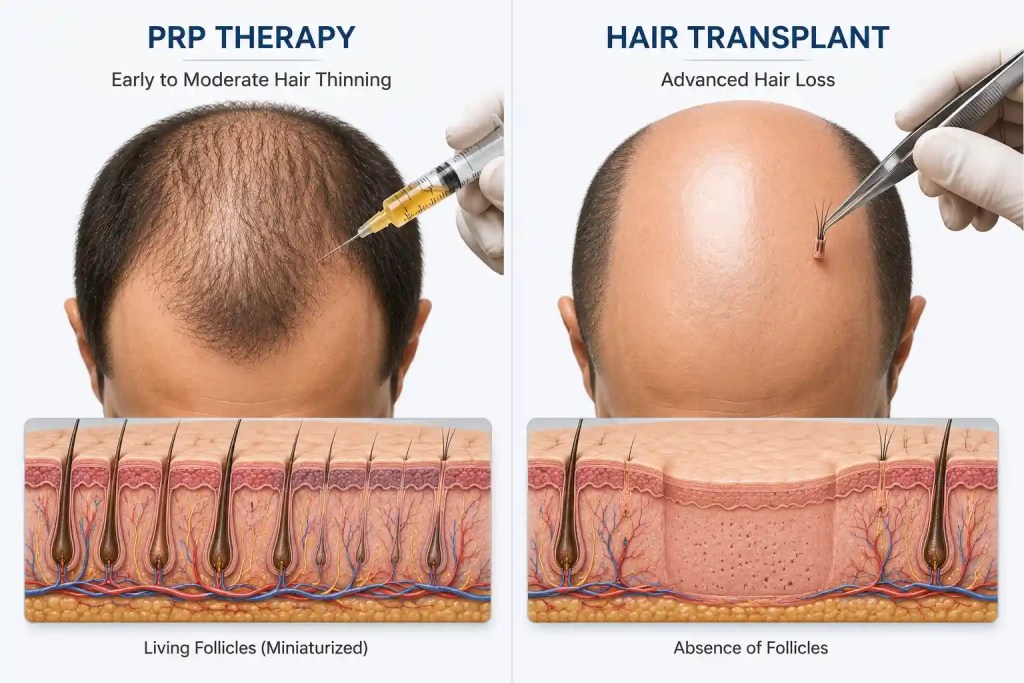
Good candidates: People in the early-to-moderate stages of thinning. Their follicles are still alive, but shrinking or producing thinner strands. This is where PRP has shown the most consistent results in the research above.
Poor candidates: Sometimes a patch of scalp is completely smooth, with no follicle activity at all. In that case, the follicles have likely died, and scar tissue has taken their place. PRP can’t restart something that’s no longer there. So a hair transplant would be the more relevant option at that stage.
Cost and timeline in India
These are approximate, indicative ranges. Actual pricing varies by clinic, city, and how many sessions your case needs. So treat this as a general guide, not a quote.

| What | Typical range | Timeline |
|---|---|---|
| Single session | ₹3,500 – ₹8,000 | 45–60 minutes |
| Standard 6-session course | ₹15,000 – ₹35,000 | Spread over ~6 months |
| Annual maintenance | ₹8,000 – ₹15,000 | 1–2 sessions/year |
What to expect, roughly:
- Months 1–2: Shedding usually slows down noticeably.
- Months 3–4: Existing strands tend to feel thicker and more resilient.
- Month 6 onward: Fine new hairs may start appearing in previously thinning areas.
Safety and side effects
Because the plasma is your own, there’s no risk of a blood-borne infection from another source. Immune rejection isn’t a concern, either. Here’s what you might notice in the first day or two after a session:
- Mild swelling near the injection sites, usually gone within 24–48 hours
- A dull headache the evening of the procedure
- Small bruises or redness at injection points
None of this is unique to PRP — it’s typical of any injection-based procedure. What matters more for safety is technique. The clinic should prepare plasma in a closed, sterile, single-use centrifuge system. And someone trained in the procedure should give the injections.
Frequently asked questions
Most clinics, including ours, start with a course of 4 to 6 sessions spaced about four weeks apart, then move to maintenance visits once or twice a year. The exact number still depends on how advanced the thinning is when you start.
Not much. You’ll feel the blood draw, then a series of small injections into the scalp, which is more of a pinching sensation than sharp pain. Most people describe mild swelling and a dull headache in the first day or two, but nothing that needs painkillers beyond a basic one if needed.
Shedding usually slows within the first 1 to 2 months. Thickness in existing hair tends to improve around months 3 to 4, and any fine new growth in thinning patches typically shows up from month 6 onward. So don’t expect a dramatic before-and-after after just one session.
No. PRP doesn’t create a permanent fix, since the growth factors wear off and hair follicles gradually slow down again without upkeep. That’s why an annual maintenance session or two is usually part of the plan once the initial course is done.
Yes. PRP doesn’t touch your hormones, so it’s used in both male and female pattern hair loss. In fact, the Vietnamese trial referenced earlier in this article treated 24 women alongside 17 men and reported density gains in both groups.
A single session usually runs ₹3,500 to ₹8,000, while a standard 6-session course lands between ₹15,000 and ₹35,000, depending on the clinic and how many sessions your case needs. See the cost breakdown above for the full picture, including annual maintenance pricing.
Not always; it depends on how far the hair loss has progressed. PRP works on follicles that are still alive, just weakened, so it’s suited to early-to-moderate thinning. Once a patch of scalp is completely bald with no active follicles left, PRP has nothing to restart, and a hair transplant becomes the more relevant option.
Bottom line
If you have early-stage thinning, and hard water or pollution is making it worse, PRP is a reasonable option. The research backs it up. It’s non-surgical, and it can slow shedding and improve density. But it’s not a cure-all. Results depend heavily on how advanced your hair loss already is when you start.
The best next step is an actual scalp assessment, not guessing from a mirror. You can book a diagnostic consultation at Maynee Skin, Hair & Slimming Clinic in Velachery. There, the team can review your pattern of loss and tell you honestly if PRP will help.
References
- Kieling L, Konzen AT, Zanella RK, Valente DS. Is autologous platelet-rich plasma capable of increasing hair density in patients with androgenic alopecia? A systematic review and meta-analysis of randomized clinical trials. An Bras Dermatol. 2024. Available at: pubmed.ncbi.nlm.nih.gov/39013743
- Gupta AK, et al. Platelet-rich plasma as a therapy for androgenic alopecia: a systematic review and meta-analysis. J Cosmet Dermatol. 2020. Available at: pubmed.ncbi.nlm.nih.gov/32410524
- Nguyen LV, Nguyen TTT. Effectiveness of Autologous Platelet-Rich Plasma for Androgenetic Alopecia: A Double-Center, Non-Controlled, Randomized Clinical Study in Vietnam. Clin Cosmet Investig Dermatol. 2025. Available at: pubmed.ncbi.nlm.nih.gov/40620897
This article is for general information and isn’t a substitute for a one-on-one medical consultation. Individual results vary depending on the stage and cause of hair loss; a clinical assessment is needed before starting any treatment.
About the medical reviewer
Dr. Murali K, M.B.B.S., M.S. (General Surgery), M.Ch. (Plastic Surgery), has over 15 years of clinical experience and is registered with the Tamil Nadu Medical Council. He reviewed this article for medical accuracy.