
Eye Bag Removal vs Dark Circle Treatment:
Why They Are Not the Same Thing
Most people use these terms interchangeably. But applying a dark circle serum on eye bags is like taking the wrong medicine, it does nothing at best, and delays real results at worst. Here’s what you actually need to know.
Priya had been spending on under-eye creams for nearly two years. She tried vitamin C serums, caffeine eye gels, retinol patches, and even a few expensive Korean formulations. Yet, every single morning, those puffy, heavy-looking bags under her eyes were still there stubbornly, frustratingly unchanged.
When she finally visited a dermatologist in Velachery, the diagnosis came as a complete surprise. She did not have dark circles at all. She had eye bags specifically, fat pad herniation causing under-eye puffiness. No cream in the world would have fixed that. For almost two years, she had been treating the wrong thing entirely.
Priya’s story, however, is not unique. In fact, it is one of the most common stories dermatologists hear in clinics across Chennai. Most people use the terms “dark circles” and “eye bags” interchangeably, as if they are the same problem. But here’s the thing they are two completely different concerns. They look vaguely similar. However, they form for entirely different reasons. And therefore, they respond to completely different treatments.
Using a dark circle treatment on eye bags is a bit like applying hair oil to treat dandruff. The two problems share the same general area, but they need very different solutions. Moreover, using the wrong treatment does not just waste money. It can also delay you from finding what actually works.
So let’s sort this out, once and for all.
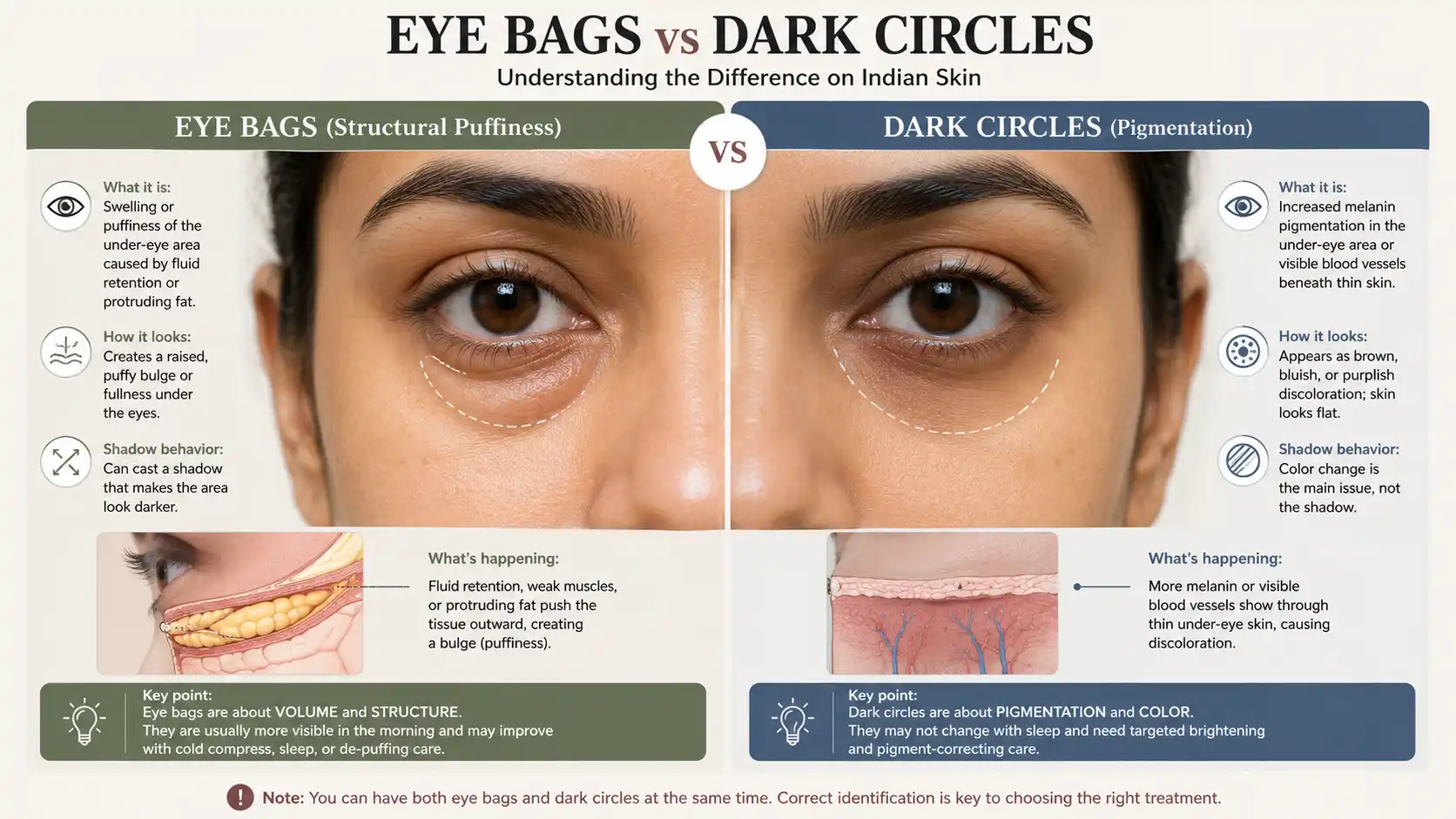
Dark circles = a colour problem. The skin under your eye appears darker than normal.
Eye bags = a structure problem. There is actual puffiness or swelling under your eye.
The treatment for one does not work for the other. In fact, using the wrong treatment can delay visible results for months or even years.
The first and most important step is an accurate diagnosis.
What Exactly Are Dark Circles?
The medical term for dark circles is Periorbital Hyperpigmentation (POH). “Periorbital” means around the eye, and “hyperpigmentation” means excess skin pigment. Together, they describe a darkening of the skin beneath and sometimes around the eyes.
However, not all dark circles are the same. In fact, dermatologists classify them into three distinct types based on their cause. Knowing the type you have is essential, because each type needs a different treatment.
The 3 Types of Dark Circles
1. Pigmentary Dark Circles (Brown / Black Tones)
These are caused by excess melanin production in the under-eye skin. They are especially common in people with Indian or South Asian skin tones, because our skin naturally produces more melanin. Sun exposure, friction from rubbing the eyes, allergies, and hormonal changes can all make them significantly worse.
2. Vascular Dark Circles (Blue / Purple Tones)
These happen because the skin under the eyes is extremely thin often less than 0.5mm, making it the thinnest skin on the entire body. Blood vessels beneath this translucent surface show through, creating a bluish or purple hue. Furthermore, fatigue, dehydration, stress, and poor circulation all dilate blood vessels, making this discolouration more visible.
3. Structural / Shadow Dark Circles
Interestingly, these are not true dark circles in the traditional sense. Instead, they are shadows created by hollowness or puffiness in the under-eye area. As we age, the tear trough deepens, and the resulting shadow looks exactly like a dark circle. This type is very commonly confused with eye bags which further complicates the diagnosis at home.
Why Are Indians More Prone to Dark Circles?
This is a critically important question, and the answer is both genetic and environmental.
First, Indian skin (Fitzpatrick Types IV–VI) has a naturally higher melanin density. This means any trigger sun exposure, rubbing, or inflammation can cause post-inflammatory hyperpigmentation (PIH) around the delicate eye area far more easily than in lighter skin tones.
Second, a published study in the Indian Journal of Dermatology found periorbital hyperpigmentation in approximately 30.8% of study participants, with 81% of those affected being women. The most common age group affected was 16–25 years, and 63% of participants had a positive family history, confirming a strong genetic link.
Third, Chennai’s intense year-round UV index means the skin around the eyes is constantly exposed to sun damage. This triggers additional melanin production, worsening dark circles particularly for those who spend time outdoors without sunscreen or UV-protective eyewear.
Furthermore, lifestyle factors extremely common in Chennai late-night work hours, long screen sessions, high-stress jobs, and high-sodium diets all contribute to periorbital darkening in distinct ways. Additionally, dust and seasonal allergens in Velachery’s urban environment trigger frequent eye rubbing, which is itself a well-documented cause of post-inflammatory hyperpigmentation.
What Exactly Are Eye Bags?
Eye bags are fundamentally a structural problem, not a pigmentation one. This is the single most important distinction to understand. Even though both look like “darkness under the eyes,” they originate from completely different anatomy.
Here is what actually happens physically. Inside your eye socket, there are small cushion-like fat pads that protect the eyeball. These fat pads are held in place by a thin membrane called the orbital septum. As we age, this membrane gradually weakens. The fat pads then shift forward and downward, settling into the area just beneath the eye. The visible result is a bulge or puffiness what we call an eye bag.
Additionally, fluid retention can cause temporary puffiness in the same area. Salty foods, alcohol, hormonal fluctuations, poor sleep, and allergies can all cause the body to retain excess water. Since the under-eye skin is so thin and delicate, fluid tends to show up there quite visibly often looking dramatically puffy by morning.
What Causes Eye Bags in Indian Adults?
Ageing and Collagen Loss
This is the most common cause. Over time, collagen production slows dramatically. The skin loses elasticity, and the orbital septum weakens. Consequently, fat migrates forward and skin begins to sag producing the classic eye bag appearance.
Genetics
Some people inherit structural features, such as prominent orbital fat pads or naturally weaker orbital septa, that make puffiness more likely from a young age. If your parents have prominent eye bags, you are significantly more likely to develop them sometimes even in your 20s.
Fluid Retention
Eating salty food, drinking alcohol, hormonal changes (especially during menstruation), and insufficient sleep can all cause the body to hold excess water. This type of eye bag is usually temporary it improves as the day goes on and the body rebalances.
Allergies and Inflammation
Allergic reactions cause histamine release, triggering inflammation around the eye. This is a very common trigger in Chennai, where dust, vehicle pollution, and seasonal allergens are present year-round. The resulting eye rubbing also damages small blood vessels and weakens the delicate skin further.
The 5 Critical Differences You Must Know
Understanding these five differences will help you avoid the most expensive mistake in under-eye skincare treating one condition as though it were the other.
| Factor | 🔵 Dark Circles | 🔴 Eye Bags |
|---|---|---|
| Nature of problem | Colour / pigmentation change | Physical structure / puffiness |
| What you see | Darker skin tone under eye | Visible swelling or bulge |
| Consistency | Consistent throughout the day | Often worse in the morning |
| Root cause | Melanin, blood vessels, shadows | Fat pads, fluid, weakened tissue |
| Do creams work? | Partially — for surface pigment | Generally, no |
| Stretch test result | Darkness stays when you pull skin | Darkness fades when you pull skin |
The single most important difference, however, is this: dark circles are a visual phenomenon, while eye bags are a physical one. You can gently press under your eye and feel an eye bag as a soft, slightly firm bulge. Dark circles, on the other hand, are purely a change in skin colour you cannot feel them at all.
How to Tell Them Apart: The 3-Step Home Test
Before spending money on any treatment, it is worth doing this simple self-test. However, this is not a substitute for a professional assessment, it is simply a starting point to help you understand what you might be dealing with.
The Stretch Test
Gently place two fingers on the skin just below your eye. Then, slowly pull the
skin outward (sideways) until it is slightly stretched. Watch carefully.
→ If the darkness fades or disappears when stretched, you likely
have structural shadows from eye bags or under-eye hollowness.
→ If the darkness stays the same or deepens, you have true
pigmentation. These are genuine dark circles.
The Morning vs. Evening Test
Check your under-eyes as soon as you wake up, before drinking water or moving
around. Then check again in the evening.
→ If puffiness is noticeably worse in the morning and reduces as
the day goes on, you likely have fluid-based eye bags.
→ If the darkness is consistent throughout the day, regardless of
sleep or hydration, you likely have pigmentation-based dark circles.
The Lighting Test
Observe your under-eyes in two different types of light, direct overhead light,
then soft side light.
→ Eye bags cast shadows that shift noticeably depending on the
direction of light. In certain lighting they look dramatically dark; in other
lighting they look fine.
→ True dark circles from pigment appear consistently dark
regardless of the light angle.
Important: Many people in Chennai have a combination of both conditions simultaneously. Even after this self-test, a dermatologist’s assessment is the only reliable way to confirm which you have and in what proportion. Getting this wrong can mean months of ineffective treatment.
Why This Is Especially Complicated for Indian Skin
For Indian skin specifically, the distinction between dark circles and eye bags becomes even harder to make at home. This is because of three compounding factors that are unique to our skin type and climate.
First, our higher melanin production means that even structural issues like eye bags cast darker shadows. So, an eye bag on Indian skin can look like a very deep dark circle, when it is actually a structural problem with no pigmentation involved at all.
Second, many South Indians have constitutional periorbital hyperpigmentation meaning the slightly darker colour around the eyes is simply part of their natural skin tone. This is not a disease or a deficiency. However, it can still be treated effectively if it causes distress.
Third, the overlap is very real. A 2025 systematic review in the Journal of Cosmetic Dermatology confirmed that periorbital hyperpigmentation is a multifactorial condition, meaning several causes frequently coexist in the same person. You can have both pigmentation-based dark circles and structural eye bags at the same time. In fact, this combination is extremely common in people aged 30 and above.
Furthermore, in Chennai’s climate high humidity, intense UV exposure, urban pollution, and increasingly sedentary indoor work, the skin around the eyes takes a daily toll. The growing IT workforce in areas like Velachery, Perungudi, and Taramani faces particular challenges: 8–12 hours of screen exposure per day, erratic sleep schedules, and chronic dehydration from working in air-conditioned environments. All of these worsen both conditions simultaneously, which is why the distinction has become harder and more important to make correctly.
Real Confusion, Real Consequences: Stories from Velachery
Sometimes, data alone doesn’t communicate the real-world cost of this confusion. So here are three situations that represent what dermatologists commonly see from patients in Velachery and the surrounding neighbourhoods of Perungudi, Taramani, Adyar, and Guindy.
12+ hours daily screen exposure. Noticed a tired, dark look under her eyes and assumed it was dark circle pigmentation. Spent ₹12,000 on serums over two years. What she actually had was tear trough hollowing a structural volume loss casting a shadow. She needed volume restoration, not a pigment treatment. Learn about our eye bag reduction treatments at Maynee Clinic.
Had been rubbing her eyes for years due to chronic dust allergies. Used multiple anti-dark circle creams with little visible change. What she had was true post-inflammatory hyperpigmentation from repeated friction genuine dark circles. Her allergy needed to be managed first, then a targeted periocular peel for the pigmentation.
Eye bags since his early 20s. Father and grandfather had the same issue. Tried cold spoons, tea bags, and every de-puffing gel available. None of it worked because his condition was genetic orbital fat herniation. He needed a clinical, structural approach to eye bag reduction.
Each of these three people had a different problem. And therefore, each needed a completely different solution. The common thread? All three spent significant time and money on the wrong thing, simply because they did not have the right diagnosis first.
Treatments That Actually Work for Dark Circles
If your self-test points toward true dark circles here is what the evidence says actually works, and why. The right treatment depends heavily on which type of dark circle you have.
Topical Treatments (For Mild / Early-Stage Pigmentation)
For pigmentary dark circles, the right active ingredients can make a meaningful difference over 8–12 weeks of consistent use. However, they work best for surface-level pigmentation only not for vascular or structural dark circles.
Brightens melanin-driven pigmentation and improves overall skin luminosity around the eye.
Reduces melanin transfer to skin cells. Particularly effective and well-tolerated by Indian skin.
Constricts blood vessels and temporarily reduces the appearance of vascular (blue-toned) dark circles.
Increasingly used in Indian skin for its melanin-inhibiting properties, especially for stubborn pigmentation.
Increases cell turnover and gradually lightens pigmentation. Also helps thicken thin under-eye skin over time.
A natural melanin suppressant derived from fungi. Effective for constitutional periorbital hyperpigmentation in Indian skin.
Professional Treatments for Dark Circles
For moderate to severe dark circles, especially the pigmentary or vascular type professional treatments deliver significantly faster and more lasting results than any topical product alone.
Chemical Peels for Under-Eye Pigmentation
Mild peels such as mandelic acid, lactic acid, or yellow peel can safely exfoliate the under-eye area, gradually reducing surface melanin. According to Indian dermatology studies, mandelic acid peels showed significant improvement in constitutional POH with minimal risk of post-inflammatory hyperpigmentation which is a real concern with stronger peels on darker Indian skin tones. Sessions in Chennai typically start from ₹2,000–₹5,000. Learn more about our specialised periocular peel treatment and chemical peel treatments at Maynee Clinic.
Q-Switch Laser Toning
The Q-switched Nd:YAG laser targets melanin directly without damaging surrounding tissue. It is particularly effective for brown-toned (epidermal) dark circles in Indian skin. Multiple sessions are usually required typically 4 to 8 for best results. Sessions range from ₹3,000 to ₹8,000 in Chennai. Speak to our dermatologist during a consultation to find out if laser toning is right for your skin.
Under-Eye Fillers (for Shadow-Type Dark Circles)
When dark circles are caused by hollowness and shadowing rather than actual pigment, hyaluronic acid fillers can restore volume and eliminate the shadow entirely. This is an important distinction: these fillers are treating a structural dark circle, not an eye bag. Costs typically range from ₹15,000–₹40,000 per session and last 12–18 months. Our team can advise on suitability during your initial consultation.
PRP (Platelet-Rich Plasma) Therapy
PRP uses growth factors from your own blood to stimulate collagen production, improve skin thickness, and reduce pigmentation. It works particularly well for vascular-type dark circles because thicker skin reduces the visibility of blood vessels beneath. Results improve gradually over 3–6 months, and 3–4 sessions are typically recommended. Ask about PRP availability during your consultation at Maynee Clinic.
Radiofrequency (RF) Skin Tightening
RF treatments stimulate collagen and thicken the under-eye skin. As a result, they reduce the translucency that makes vascular dark circles visible. Additionally, they improve overall skin quality in the periorbital area making them a good supporting treatment in combination protocols.
Treatments That Actually Work for Eye Bags
If your self-test points toward eye bags, the treatment path is fundamentally different. Creams, serums, peels, and laser pigmentation treatments will not resolve structural eye bags. Here is what the evidence says actually helps — and what definitely does not.
Non-Surgical Options (For Mild to Moderate Eye Bags)
RF energy heats deep skin layers, tightening the orbital septum and stimulating collagen production. This reduces the laxity that allows fat pads to herniate forward. Multiple sessions are usually needed, but visible results are achievable for mild-to-moderate cases. Ask about this option during a consultation.
HIFU delivers focused ultrasound energy to deep tissue layers, triggering a collagen-rebuilding process that gradually tightens the under-eye area. Results improve over 3–6 months and can last up to a year or more. Speak to our team to find out if HIFU is suitable for your case.
This treatment involves injecting small amounts of carbon dioxide gas under the skin. The CO₂ triggers increased blood flow and stimulates skin repair. As a result, it reduces puffiness and improves the appearance of under-eye bags over a course of sessions.
For mild eye bags, fillers can be placed around the puffy area to create a smoother transition between the cheek and the bag, making it far less noticeable. This is different from fillers used for dark circles, but both use hyaluronic acid for different purposes. Suitability is assessed individually at consultation.
Learn more about our non-surgical and clinical approaches on our dedicated eye bag reduction page.
Surgical Option (For Severe Eye Bags)
Blepharoplasty (Lower Eyelid Surgery)
For eye bags caused by significant fat herniation that does not respond to non-surgical methods, a lower blepharoplasty removes or repositions the displaced fat pads. Results are long-lasting — typically 5 to 10 years. However, this is a surgical procedure that requires careful selection of a qualified oculoplastic or cosmetic surgeon, and a period of recovery.
⚠️ What definitely does NOT work for structural eye bags:
Caffeine eye gels, vitamin C serums, cold cucumber slices, or under-eye patches. These may temporarily reduce some morning fluid puffiness. However, they absolutely cannot address structural fat herniation. If you have been relying on these for months with no change, it is a clear sign the problem is structural — not topical.
Can You Have Dark Circles and Eye Bags at the Same Time?
Yes — and in fact, this is very common, especially for people over 35 in Chennai. The two conditions frequently coexist for a straightforward reason: ageing affects the face on multiple levels simultaneously. Fat pads shift (causing eye bags) while melanin production increases (causing dark circles), and the skin thins (making blood vessels more visible). All three processes often happen together.
In fact, what many people describe as “very dark, heavy eye bags” is typically a combination of three overlapping issues: actual structural puffiness from fat migration, plus true melanin pigmentation, plus shadows cast by the hollowness around the bag all happening simultaneously.
Therefore, when both conditions coexist, treatment needs to address both. A single solution is simply not sufficient. In fact, a combined approach — such as our periocular peel for surface pigmentation alongside our eye bag reduction treatment for the underlying structural issue — is often the most effective path to clear, lasting results.
This is exactly why an accurate consultation before any treatment is so important. Without proper diagnosis, you risk treating only half the problem and wondering why you are seeing only partial improvement.
What Does Under-Eye Treatment Actually Cost in India?
Understanding realistic costs helps you plan your treatment journey properly and avoid being surprised. Costs in Chennai may vary based on the clinic, technology used, dermatologist’s experience, and the number of sessions required for your specific case.
| Treatment | Addresses | Approx. Cost / Session | Sessions Needed |
|---|---|---|---|
| Chemical Peel (Under Eye) | Dark circles (pigment) | ₹2,000 – ₹5,000 | 4 – 6 |
| Q-Switch Laser Toning | Dark circles (melanin) | ₹3,000 – ₹8,000 | 4 – 8 |
| PRP Therapy | Dark circles (vascular) | ₹5,000 – ₹12,000 | 3 – 4 |
| RF Therapy | Eye bags (structural) | ₹4,000 – ₹10,000 | 4 – 6 |
| HIFU | Eye bags (structural) | ₹8,000 – ₹20,000 | 1 – 2 |
| Under-Eye Fillers | Both (different mechanisms) | ₹15,000 – ₹40,000 | 1 – 2 |
| Blepharoplasty (Surgical) | Eye bags (severe) | ₹60,000 – ₹1,50,000 | Surgical procedure |
* Costs are approximate and may vary based on clinic, technology, dermatologist experience, and the number of sessions required for your specific case. Always request a proper consultation and treatment plan before committing.
When Should You Stop Self-Treating and See a Dermatologist?
Home remedies and over-the-counter products genuinely have their place. However, there are clear signs that it is time to move to professional care. If any of the following apply to you, continuing to self-treat is likely to cost more time and money in the long run:
- You have used products consistently for 3 or more months without meaningful improvement
- The puffiness or darkness is getting worse, not staying the same
- The condition is affecting your confidence at work or in social situations in Velachery and Chennai
- You notice asymmetry — one eye looks noticeably different from the other
- You have a family history of prominent eye bags, suggesting a genetic structural component
- Your dark circles appear across all colours brown, blue, and shadow-based simultaneously
- You are genuinely unsure whether you have dark circles, eye bags, or both
The Diagnosis Comes First, Always
In Velachery and across Chennai, more people are now seeking professional assessments early — before wasting months on the wrong products. At Maynee Skin, Hair & Slimming Clinic, under-eye concerns are always approached with a thorough skin assessment before any treatment is recommended. A proper consultation identifies the exact type and cause whether it is pigmentation, vascular, structural, or a combination and builds a targeted plan accordingly. That diagnosis, more than any product or procedure, is what separates a successful outcome from years of frustration.
Book a Consultation →Frequently Asked Questions
The Right Treatment Starts with the Right Diagnosis
Eye bags and dark circles may share a neighbourhood — the area just under your eyes. But they are very different problems with very different solutions. As we have seen throughout this guide, treating one as though it were the other is the most common — and often the most expensive — mistake in under-eye skincare.
Dark circles are a colour problem. Eye bags are a structural problem. Therefore, their treatments must match their causes. Furthermore, in Indian skin — and especially in Chennai’s unique climate — the two conditions often coexist, which means both may need to be addressed simultaneously through a well-designed combination approach.
If you live in Velachery or anywhere in Chennai and have been struggling with under-eye concerns without seeing real results, the most valuable step is not buying another product. Instead, it is getting an accurate diagnosis. Once you understand exactly what you are dealing with, the right treatment becomes far clearer — and the results, finally, become visible.
Your eyes deserve the right solution. Not just any solution.
This article is for informational and educational purposes only. It is not a substitute for professional medical advice, diagnosis, or treatment. Always consult a qualified dermatologist for concerns about your skin. Individual results vary based on skin type, condition severity, and treatment adherence.