Many people across India feel trapped in a painful monthly loop. For instance, we spend years tolerating hot salon wax, sharp razors, or painful ingrown hairs. Eventually, we all look for a better way out of this cycle.
Naturally, you will look into laser hair removal as an alternative. But does it actually last forever? Let us look at the raw clinical facts to find out.
The short answer is clear. The US FDA approves lasers for permanent hair reduction, not absolute removal.
This means it will not stop every single hair forever. However, it permanently reduces total hair by 80% to 90%. Consequently, any hair that grows back will be thin and light. For example, it looks just like soft baby fuzz.
How the Technology Works
To understand the results, you must understand the basic science. First, the process uses a rule called selective photothermy. This simply means using light to target a specific spot.

First, a trained specialist passes the laser over your skin. Next, the dark pigment in your hair absorbs this light. Then, the light instantly changes into deep heat. This heat travels down the strand to the root. Consequently, that specific root loses the power to grow new hair.
Why You Need Multiple Sessions
If the laser destroys the root, why do you need multiple visits? The answer lies in your body’s natural hair growth cycle. Our hair always rotates through three separate stages.
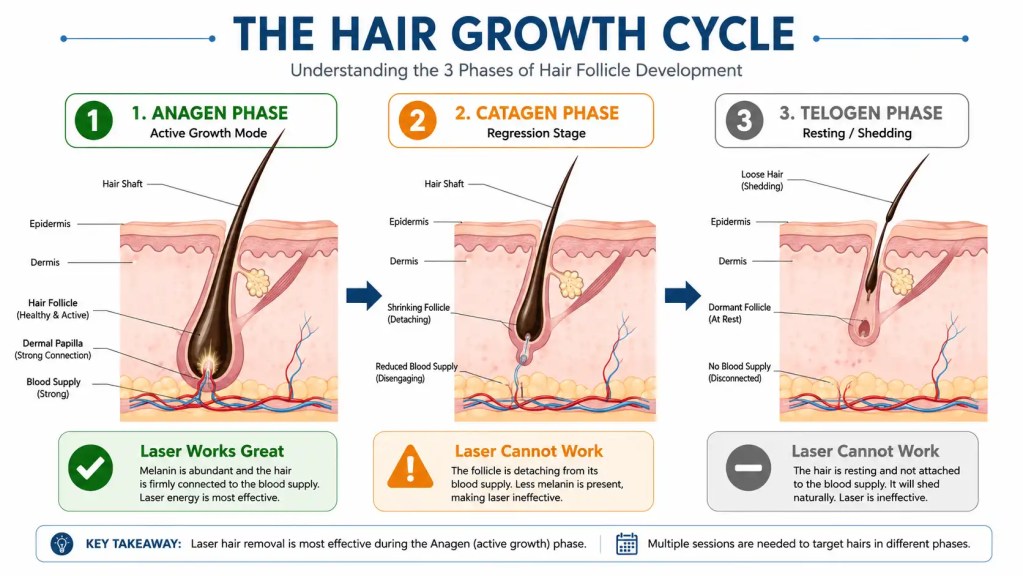
- The Anagen Phase (Active Growth): The hair connects directly to the root. Therefore, this connection lets the heat destroy the follicle. Lasers only work during this phase.
- The Catagen Phase (Regression Stage): The hair stops growing. As a result, it detaches from the root base.
- The Telogen Phase (Resting Mode): The follicle rests while the old hair falls out.
Right now, only about 15% of your hair is in the active growth phase. The rest is resting. Therefore, one session can never hit every hair. Because of this, you must wait a few weeks between visits. This delay lets the sleeping hair enter the active phase.
Choosing the Right Laser for Indian Skin
Skin tones are categorized using the Fitzpatrick Scale. This scale runs from Type I (very fair) to Type VI (deeply pigmented).
Most Indian skin tones fall beautifully between Type III and Type VI. Therefore, your clinic must choose the right machine carefully. For example, older lasers could burn dark skin by mistake. Fortunately, modern technology has solved this issue completely.
| Laser Type | Wave Length | Best Skin Type | Primary Benefit |
| Triple-Wavelength Diode | 755nm + 810nm + 1064nm | All Indian Skin (III to VI) | Extremely safe, fast, and comfortable for mixed tones. |
| Nd:YAG Laser | 1064nm | Darker Skin (V and VI) | Bypasses surface skin safely to hit deep roots. |
| Alexandrite Laser | 755nm | Fair Skin (I to III) | Works fast but carries high risks for dark skin. |
Pro Tip: Premium setups like the Alma Soprano Ice Titanium Plus use a cold sapphire tip. This tip cools the skin surface during the blast. As a result, the treatment feels almost painless.
Real Client Concerns Along the OMR Corridor
Living in a busy tech hub creates unique skin issues. For example, tech professionals living along Old Mahabalipuram Road (OMR) face specific daily challenges.
The Hard Water Problem
Many residents in Thoraipakkam, Navalur, and Sholinganallur struggle with hard groundwater. This mineral-heavy water damages your natural skin barrier. Consequently, your skin becomes dry, itchy, and highly sensitive.
Therefore, you must protect sensitive skin before any laser session. Because of this, visiting an expert team is vital. For instance, the dermatologists at Maynee Skin, Hair & Slimming Clinic on OMR always check your hydration levels first. Furthermore, they adjust the laser power to fit your skin condition perfectly. They also provide soothing creams to keep your skin safe.
Sun Exposure and Commuting
Additionally, commuting through OMR dust and harsh sunlight stresses your skin. If you face heavy sun right after a laser session, you might get dark spots. Therefore, top clinics customize your after-care plan to match your daily travel schedule.
The Financial Math: Lasers vs. Salon Waxing
Many people hesitate when they see the price of a clinic package. However, traditional salon waxing actually costs much more over time. Let us look at a basic 10-year budget comparison.
Option A: Regular Salon Waxing
- Average Cost: ₹2,500 for a full-body wax session.
- Frequency: Once every month.
- 1-Year Cost: ₹30,000
- 10-Year Total:$$₹30,000 \times 10 = \mathbf{₹3,00,000}$$
Option B: Medical Laser Treatment
- Initial Clinic Package: Around ₹65,000 for 6 to 8 sessions.
- Maintenance: One quick touch-up per year for stray hairs, costing roughly ₹8,000.
- 10-Year Total:$$₹65,000 + (₹8,000 \times 9) = \mathbf{₹1,37,000}$$
Waxing Cost (10 Years): ₹3,00,000Laser Cost (10 Years): ₹1,37,000Total Cash Saved: Save over ₹1.60 Lakhs
By choosing a laser package, you save over ₹1.60 Lakhs. Concurrently, you save hours of salon time and protect your skin from hot wax.
What to Expect: Your Step-by-Step Guide
To get smooth skin safely, you must follow a clear medical plan.
1.Doctor Consultation:Day 1.
Meet with a qualified doctor. First, they check your skin type and review your health history. They also check for hormonal issues like PCOS.
2.Stop Plucking and Start Shaving:2 Weeks Before.
Stop all waxing, threading, or plucking completely. Because of this, the root stays inside the skin. However, you should shave the area cleanly 24 hours before your session.
3.The Laser Session:Every 4 to 6 Weeks.
The expert applies a cold gel to your skin. Next, you put on safety goggles. Then, the laser moves smoothly, causing only a mild snapping feeling.
4.Skin Care and Protection:1 Week After.
Apply pure aloe vera gel to cool the skin. After that, avoid hot baths and heavy gym workouts for two days. Most importantly, apply SPF 50 sunscreen daily.
The Truth About Hormones and Touch-Ups
Sometimes, people notice a few fine hairs sprout back after a few years. Do not worry, as this is completely normal for a living body.
Our hair follicles respond to internal chemical shifts. For example, major life events like high work stress, pregnancy, or conditions like PCOS alter your hormone balance. These changes can signal soft, invisible baby fluff to turn into darker hair.
However, this shift does not mean your original laser sessions failed. Instead, your body simply made brand new hair paths. Fortunately, you can manage this easily. A quick, single touch-up session once a year at a trusted center like Maynee Clinic keeps your skin perfectly smooth.
Final Thoughts
Ultimately, lasers do not offer a magical, 100% cure for every single hair forever. However, they give you something better: a permanent drop in hair growth. Consequently, this change frees you from stressful, last-minute salon trips before a trip or a meeting.
Instead of throwing money away on temporary monthly waxing, you can invest in lasting smoothness. Simply pick a medical clinic that uses safe, certified tools and understands your local environment.
Frequently Asked Questions
The US FDA officially classifies laser technology as a method for permanent hair reduction, not 100% absolute hair removal. A full clinical course using advanced platforms destroys roughly 80% to 95% of active terminal hair follicles. Consequently, any rare hair that returns years later will grow back as incredibly fine, slow-growing baby fuzz. This provides a practical lifestyle transformation that eliminates your monthly salon routine.
Yes, it is entirely safe when performed by qualified professionals using modern, long-pulse wavelengths. Older cosmetic machines struggled to separate the dark pigment in the hair root from the natural melanin in deeper skin tones. Fortunately, modern premium platforms deploy specific Nd:YAG (1064nm) or advanced Triple-Wavelength Diode technologies that safely bypass surface skin layers to target only the root bulb without causing burns.
Hard water, which is a frequent concern for residents across the OMR corridor (including Thoraipakkam and Sholinganallur), strips natural lipids and compromises your skin barrier. This leaves the skin feeling chronically dry and highly sensitive. Because of this, it is vital to visit an expert facility like Maynee Skin, Hair & Slimming Clinic on OMR. Their medical teams evaluate your skin’s barrier hydration profile first, adjust the laser parameters to accommodate any sensitivity, and provide customized, barrier-repairing aftercare.
On average, most individuals require 6 to 8 structured clinical sessions to achieve optimal, long-term reduction. This requirement exists because lasers can only destroy hair roots during their active growth phase (the Anagen phase). Since only a fraction of your body hair is actively growing at any single moment, sessions must be spaced 4 to 6 weeks apart to catch the remaining dormant follicles as they wake up.
Unlike the painful, skin-tearing pull of hot salon wax, modern clinical laser reduction is highly comfortable. Top-tier clinical systems use integrated sapphire cooling tips that instantly chill the top layer of skin before and during each light pulse. This cooling action changes the sensation to a mild, cold snapping feeling against the skin, making the entire process virtually painless.
Yes, laser treatment is highly recommended by dermatologists to manage thick facial hair caused by Polycystic Ovary Syndrome (PCOS). However, because PCOS involves continuous internal hormonal fluctuations, your body can naturally activate brand-new hair follicles over time. While the follicles destroyed by your initial sessions stay gone, you will simply need quick, annual touch-up sessions to keep any hormone-triggered growth completely clear.
Your skin remains temporarily heat-sensitized for 24 to 48 hours following a treatment session. If you commute through the intense sun, dust, and pollution of OMR without protection, you run a high risk of developing temporary dark spots or hyperpigmentation. Therefore, it is essential to apply a broad-spectrum sunscreen daily and follow a customized, protective aftercare routine tailored to your lifestyle.
The laser light relies on the hair strand to act as a dark pathway to channel heat directly down to the root bulb. If you wax, thread, or pluck before your appointment, you pull the root out completely, leaving no target for the laser. Shaving keeps the root perfectly intact beneath the surface while clearing away excess hair length above the skin, preventing painful surface burns.
Yes, traditional hair removal methods routinely compromise your skin barrier. Shaving creates microscopic tears, while waxing violently pulls the hair from its sheath, leading to localized inflammation, bumps, and painful ingrown hairs. Conversely, laser hair reduction clears the root entirely, meaning it doesn’t just stop hair growth, it completely resolves the root cause of ingrown hairs forever.
When viewed as a long-term investment, clinical laser treatments are significantly more cost-effective than continuous salon visits. Over a 10-year span, regular full-body waxing at mid-tier salons compounds to approximately ₹3,00,000. Conversely, an advanced, medical-grade laser package combined with occasional annual touch-up maintenance totals roughly ₹1,37,000. This switch saves you over ₹1.60 Lakhs while entirely reclaiming your personal time and protecting your skin from long-term damage.