
Turning 35 is a major milestone for Indian women. So, you might notice your skin changing. For instance, you may see fine lines. Also, your jawline might look less sharp. This happens because your skin loses natural collagen every year. Therefore, many women look for the best anti-aging treatments. But, picking the right choice can feel very hard. Today, you can choose between quick clinic visits and big operations. Specifically, the debate is usually about thread lifts versus surgical facelifts.

Understanding the Visual Mechanics
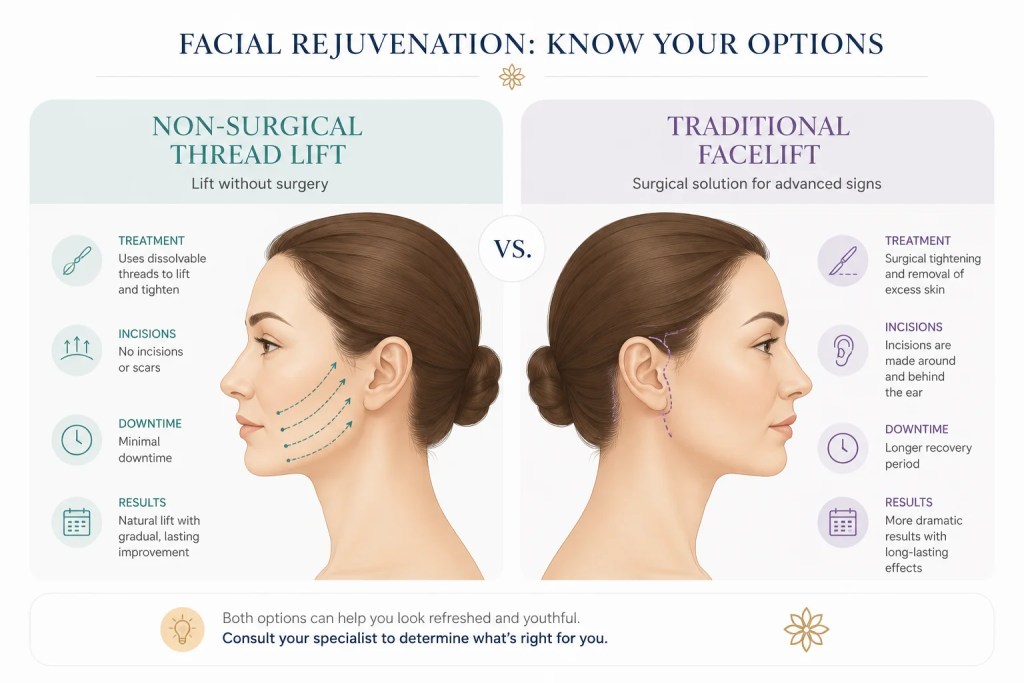
Look at the guide below to see how a thread lift works.
First, the doctor marks your face. Next, they use very fine needles. Then, they place small threads under your skin. Finally, they pull and trim the threads. As a result, your skin looks tight and smooth right away.
What is a Thread Lift?
A thread lift is a quick skin treatment. First, a doctor puts thin medical threads under your skin. So, these threads pull your skin up immediately. In addition, the threads are safe and dissolve over time. Meanwhile, they help your body grow new collagen. Therefore, your skin stays tight for many months. Because of this, it is a great non-surgical choice.
What is a Surgical Facelift?
In contrast, a surgical facelift is a real medical operation. First, a surgeon makes cuts near your ears. Then, they pull up the deep facial muscles. Also, they trim away your extra sagging skin. Consequently, this fix lasts for many years. But, it requires a lot of healing time. Therefore, it is a much bigger commitment for your schedule.
Head-to-Head Comparison
Choosing between these paths requires balancing a few practical points. Therefore, this simple table outlines the exact differences you can expect.
| Feature Comparison | The Thread Lift Route | The Surgical Facelift Route |
| Primary Goal | Mild lift & new collagen | Permanent, deep structural change |
| Procedure Time | 45 to 60 minutes | 3 to 5 hours |
| Anesthesia | Local numbing cream | General anesthesia |
| How Long It Lasts | 12 to 24 months | 7 to 12 years |
| Downtime | 2 to 4 days | 2 to 4 weeks |
| Average Cost in India | ₹20,000 – ₹1,20,000 | ₹1,50,000 – ₹3,50,000+ |
Hyper-Local Realities: The Porur Environmental Factor
Living in a busy city area changes how your skin heals. For example, women in Porur face special daily challenges. So, you must think about these local issues before you choose.

1. The Hard Water Problem
Specifically, local hard water strips your skin barrier. Because of this, 35+ skin can become very dry. If you get a facelift, hard water can irritate your healing cuts. Therefore, you must use pure bottled water to wash your face.
2. Intense Heat and Sweat
Furthermore, the local climate brings intense heat and sweat. For instance, sweat can bring bacteria to open wounds. If you get a big surgery, managing sweat is very hard. However, a thread lift only leaves tiny needle pricks. So, it is much easier to protect in hot weather.
3. Heavy Traffic Dust
Additionally, heavy commuter dust can clog your healing pores. For example, dust triggers skin inflammation. As a result, low-downtime treatments are best for active women in this area.
Interactive Treatment Suitability Calculator
Are you still unsure which path matches your life? Therefore, you can use this simple tool to check your needs.
Treatment Suitability Calculator
Personalized Recommendations & Precautions
The Recovery Journey: Step-by-Step
Proper aftercare ensures you get the best results. Consequently, following an organized protocol is essential.
1.The First 48 Hours:Immediate Care.
Keep your face clean. Also, avoid touching your skin. For example, use ice packs to stop swelling. Furthermore, sleep strictly on your back.
2.Days 3 to 7:Water Adjustments.
Avoid intense heat and sun. Specifically, do not use hard groundwater on your face. Instead, use clean bottled water. Consequently, your skin heals without irritation.
3.Weeks 2 to 4:Back to Normal.
If you chose threads, your face is now settled. However, if you chose surgery, your deep tissues are still healing. Therefore, avoid heavy gym workouts.
An Expert Note on Aging: Thread lifts do not stop time. Instead, they gracefully delay it. Because of this, many women view threads as a great first step before deep wrinkles settle.
In the end, your choice depends on your daily life. For instance, busy women usually prefer quick fixes. Luckily, you can get expert advice right in your neighborhood. For example, you can visit an advanced local facility like Maynee Cosmetology Clinic, Porur. There, an expert doctor can check your skin. Then, they will help you pick the perfect plan for your face.
Frequently Asked Questions
A traditional surgical facelift lasts significantly longer than a thread lift. Specifically, a surgical facelift alters deep facial muscles to provide stable structural results for 7 to 12 years. In contrast, a thread lift uses dissolvable medical sutures. Consequently, the temporary lifting effect naturally softens as the threads dissolve, lasting between 12 to 24 months.
In Chennai, a thread lift is far more affordable than a surgical facelift. For example, a typical thread lift procedure ranges from ₹20,000 to ₹1,20,000 depending on the number of sutures used. On the other hand, a full surgical facelift is a major hospital operation. Therefore, the average price scales from ₹1,50,000 to over ₹3,50,000 due to operating theater fees and general anesthesia costs.
No, 35 is actually the ideal starting age for a thread lift treatment. Around this phase, the skin begins to experience early collagen loss and mild skin laxity. Consequently, placing medical threads at this point triggers a strong preventative collagen response. This subtly delays the need for more invasive surgeries later in life.
No, thread lifts do not cause permanent scarring or post-inflammatory hyperpigmentation (PIH) when performed correctly. Because doctors use ultra-fine needles rather than surgical knives, there are no open incisions to leave a scar. However, Indian skin tones are sensitive to deep trauma. Therefore, choosing an experienced practitioner ensures the threads are placed safely beneath the pigment layer.
The difference in recovery time is massive. Specifically, a thread lift requires a short downtime of 2 to 4 days, meaning you can return to office work almost immediately. In contrast, a traditional surgical facelift involves extensive deep-tissue healing. Consequently, patients must take a strict 2 to 4 weeks off from active professional and social schedules.
No, a thread lift cannot fully correct severe skin sagging or heavy jowls. For instance, threads work best for mild to moderate lifting in the cheek and early jaw areas. If a patient experiences deep, continuous skin folds and extreme laxity, a surgical facelift is necessary. Only a surgeon can safely cut away the heavy excess tissue to restore sharp contours.
Intense local humidity accelerates sweat production, which can introduce external bacteria to healing skin. If you undergo major surgery, managing sweat around large incisions near the hairline becomes very challenging. However, thread lift entry points are microscopic. Therefore, they are much easier to keep clean and dry during hot weather.
You must avoid using municipal or ground hard water on your face during early healing. Specifically, high mineral content can break down your skin barrier and irritate raw needle entry points. For instance, you should use clean, bottled distilled water alongside a gentle, soap-free cleanser for the first week to ensure zero irritation.
Yes, combining threads with other non-surgical options creates a highly effective “liquid facelift.” For example, dermal fillers restore lost volume in hollow cheeks, while Botox relaxes active forehead wrinkles. Meanwhile, the threads pull up sagging jawlines. Consequently, staging these procedures together provides comprehensive rejuvenation without surgery.
Yes, non-surgical thread lifts are partially manageable if adjustments are needed. If minor asymmetry occurs, an experienced doctor can sometimes manipulate the thread tension early on. Furthermore, because the materials are fully bio-absorbable, any unwanted effects disappear entirely once the threads dissolve naturally.