
Many people in Tamil Nadu want smooth, glowing skin. This desire leads them to try collagen induction therapy, which is the scientific name for microneedling. As a result, a major choice pops up. Should you buy a cheap dermaroller online to use at home? Or is it better to book a professional session at a specialized clinic?
The Verdict: Clinical Microneedling vs. At-Home Dermaroller
Clinical microneedling is vastly superior and safer than using an at-home dermaroller. Professional treatments use automated, motorized pens that puncture the skin at a perfect, rapid 90-degree angle, safely triggering deep collagen remodeling to fix deep acne scars, wrinkles, and texture issues. In contrast, at-home rollers feature fixed, shallow needles ($0.25\text{ mm}$ to $0.5\text{ mm}$) that only aid basic serum absorption; worse, their curved entry and exit angles cause lateral micro-tears, increasing the risk of infection, skin tearing, and hyperpigmentation.

Both methods claim to fix acne scars, fine lines, and uneven texture. However, the actual science, safety, and results are vastly different. Therefore, understanding these differences is vital before you choose. Making the wrong choice can cause severe damage that is costly to fix.
1. The Real Science: Clean Holes vs. Skin Tears
The biggest difference between these two methods is how the tiny needles enter your skin. This basic mechanism changes how your body heals.
Clinical Needle Pens (Straight and Clean)
Professional skin clinics use advanced, motorized pens. These electronic devices use sterile, single-use needle tips. The pen moves up and down at rapid speeds. Because of this automated speed, the needles enter the skin at a perfect 90-degree straight angle.
Consequently, this clean movement creates neat, microscopic holes without tearing the surrounding tissue. This precise action tells your body to grow fresh, healthy collagen. You can read more about how microneedling with dermaroller and electronic pens compares in medical literature regarding wound healing.
At-Home Dermarollers (Angled and Risky)
In contrast, an at-home roller relies on a manual rolling wheel. As you roll the wheel across your face, the needles enter at one angle and exit at another. Therefore, this curved motion causes lateral micro-tears, which are tiny slices in the skin.
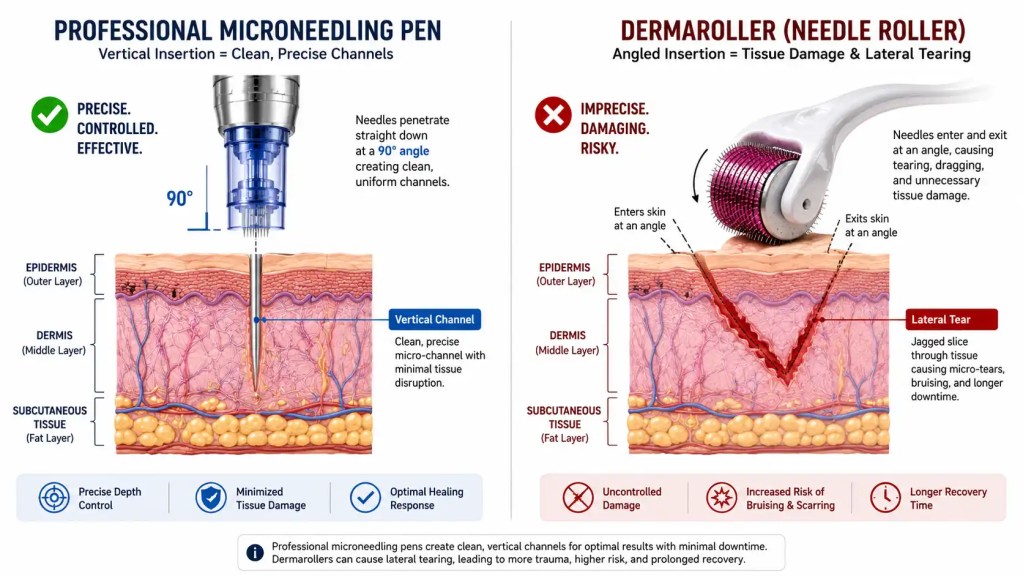
Instead of helping, these tiny cuts can slice your delicate blood vessels. Over time, this harsh pulling can weaken your skin barrier and cause micro-scarring.
2. Needle Depth: Precise Care vs. One-Size-Fits-All
Your face does not have the same skin thickness all over. For instance, the skin around your eyes is thin, but the skin on your cheeks is much thicker. To stay safe, you must control how deep the needles go.
| Skincare Feature | Clinical Microneedling | At-Home Dermaroller |
| Depth Control | Adjusts instantly ($0.25\text{ mm}$ to $2.5\text{ mm}$) | Fixed depth (usually $0.25\text{ mm}$ to $0.5\text{ mm}$) |
| Skin Layer | Reaches deep layers for real change | Stays on the very top layer |
| Best Used For | Fixes deep acne scars and wrinkles | Helps skin absorb basic facial serums |
| Safety Habits | Uses new, sterile needles every time | Reused often; very hard to clean |
During a clinical session, a trained expert adjusts the needle depth continuously. For example, they will use a shallow depth on your forehead. Then, they will switch to a deeper setting on your cheeks to break down deep acne scars.
On the other hand, home rollers use short, fixed needles so you do not hurt yourself. While this makes them safer for home use, it also means they cannot reach the deep layers where true scarring lives. As a result, home tools cannot fix deep, stubborn scars.
3. The Danger of Dark Spots and Infections
Clean habits are a major reason to choose a professional clinic over your bathroom. Clinical treatments happen in ultra-clean rooms with sterile tools.
Meanwhile, home rollers easily collect bad bacteria. Washing your roller with regular rubbing alcohol sanitizes the surface, but it does not fully sterilize the deep parts of the tool. Soon, dead skin, facial oils, and germs build up at the base of the needles. If you reuse a dirty roller, you can cause painful infections like folliculitis or severe acne breakouts.
Furthermore, people with rich Indian skin tones face a high biological risk for Post-Inflammatory Hyperpigmentation (PIH), which means dark, patchy spots. When a home roller creates rough cuts, your skin gets stressed. To protect itself, it produces too much melanin. Consequently, you end up with dark patches and uneven skin color. To understand how melanin-rich skin responds to trauma, you can look into the clinical research on hyperpigmentation disorders in Fitzpatrick skin types.
Important Warning: Trying to clear dark spots at home with an aggressive roller usually backfires. The harsh trauma triggers a defensive pigment release, which makes the original dark spots look much darker.
4. Facing Local Skin Hazards in Madurai
Your environment plays a massive role in skin healing. In a city like Madurai, local residents face unique challenges that alter how the skin recovers.
- Intense Sun and High Heat: Madurai is famous for its hot, sunny climate. After any needling session, your skin barrier stays open and weak for a day or two. If you step out into harsh sunlight during this time, you can trigger rapid dark spots. For this reason, professional clinics offer medical-grade sunscreens and strict recovery steps to protect you.
- Hard Groundwater Issues: Many homes across Madurai rely on groundwater that contains heavy minerals. Bathing your freshly treated face in hard water can cause severe dryness, scaling, and painful irritation.
- Heavy Road Dust and Smoke: Traveling through busy areas like Goripalayam or Mattuthavani exposes your skin to thick smoke and dust. If these tiny pollution particles get trapped inside open skin channels, they can trigger deep breakouts and painful swelling.
Because of these factors, local skin care teams, like the experts at Maynee Skin, hair & Slimming Clinic in Madurai, customize their post-care plans. They adjust the recovery step-by-step based on local water quality and weather to keep your skin completely safe.
5. Professional Safety and Long-Term Results
A real clinical treatment is highly personalized. Before anything begins, a specialist checks your face to ensure it is healthy. If you have active cystic acne, rosacea, or open sores, they will not perform the treatment. This is because needling over active acne spreads bacteria across your entire face, which makes breakouts worse.
During a clinical visit, professionals apply strong numbing creams so you feel no pain. This step allows them to treat deeper layers comfortably. Additionally, they use this time to push medical-grade vitamins and hyaluronic acid deep into the open channels. Therefore, your skin absorbs these active nutrients quickly, leading to rapid, vibrant healing.
[Home Dermaroller] --> Angled Entry --> Rough Tears --> Superficial Layer Only[Clinical Needling] --> Straight 90° --> Clean Holes --> Deep Collagen Growth
In short, choosing professional sessions is a safe and reliable way to care for your face. While home rollers are okay for basic product absorption, they cannot fix deep texture problems. For deep scars, fine lines, and safe results, professional tools and expert hands are always your best option.

Frequently Asked Questions
Yes, clinical microneedling is vastly superior for deep structural scars. At-home dermarollers are only designed to reach the superficial top layer of your skin (0.25mm to 0.5mm) to ensure safety. However, stubborn boxcar or rolling acne scars sit much deeper within the dermal layer. Clinical motorized pens can safely penetrate up to (2.5mm) to break down tough scar tissue. Therefore, home rollers are unable to trigger the deep collagen remodeling required to smooth out permanent scarring.
Unfortunately, yes. Because manual rollers enter and exit the skin at a curved angle, they can create microscopic lateral tears across your face. If you apply too much pressure or use bent needles, you risk slicing delicate blood vessels and causing micro-scarring. Furthermore, aggressively rolling over dark spots frequently triggers a defensive melanin release, making hyperpigmentation look much darker and uneven.
Protecting your skin from the intense tropical sun is absolutely vital for preventing Post-Inflammatory Hyperpigmentation (PIH). For the first 24 to 48 hours after your procedure, your skin channels remain wide open and highly sensitive. Stepping out into harsh heat without protection can cause rapid darkening. To avoid this, clear skin centers provide advanced, medical-grade, non-comedogenic sunscreens alongside tailored recovery schedules designed specifically for local weather conditions.
No, you should never use a needle device over active pimples or cystic acne. Rolling across a live breakout punctures the pustules and spreads acne-causing bacteria across your entire face. This mistake instantly triggers severe, widespread inflammation and fresh breakouts. A professional skin specialist will always evaluate your face first and treat around sensitive areas while managing active flare-ups safely.
Professional clinics utilize single-use, medical-grade needle cartridges that are opened right in front of you and safely discarded immediately after your session. The main device itself undergoes strict clinical sterilization protocols. In contrast, household rubbing alcohol (70% isopropyl alcohol) only sanitizes the surface of a home roller. It cannot completely eliminate deeply trapped skin oils, dead cells, and stubborn bacteria hiding at the base of the fixed needles.
When you create microscopic channels in your skin, your natural protective barrier is temporarily lowered. Many households in regional areas rely on groundwater that contains high levels of dissolved minerals like calcium and magnesium. Washing an open, freshly treated face with this hard water can cause severe dryness, scaling, and painful mineral irritation. Consequently, customized post-care routines often include using distilled or purified water for the initial wash.
Surprisingly, clinical microneedling is often much more comfortable. Because professionals apply a high-strength, medical-grade topical numbing cream before the treatment begins, you will feel very little during the session. Additionally, the motorized pen punctures the skin at a perfect, rapid 90-degree vertical angle, which is much smoother than the slow, scraping pull of a manual home roller wheel.
While a basic home roller is used consistently just to help facial serums absorb better, clinical treatments deliver long-term structural changes. Most individuals notice an improved, softer skin texture within two weeks. For significant skin concerns like deep wrinkles, large open pores, or deep acne scars, a structured series of 3 to 6 professional sessions spaced 4 to 6 weeks apart is generally recommended.
For the first 24 to 48 hours, you must avoid heavy sweating, intense workouts, hot showers, and makeup to prevent blocking your open skin channels. Additionally, you should avoid traveling through heavily polluted or dusty urban areas without protection. Airborne dust and smoke particles can easily settle into the micro-channels, causing deep-seated irritation or painful swelling.
You should always look for a specialized aesthetic center that prioritizes certified dermatological expertise, clear hygiene standards, and customized care plans. Reliable regional skin care teams, such as Maynee Skin, Hair & Slimming Clinic in Madurai, understand how local environmental factors like hard water and intense summer heat affect your recovery. They design personalized post-care routines to ensure your skin heals beautifully and safely.