
Hey. If you’re dealing with beard hair loss or random patchy spots, you’re not alone. This topic doesn’t get talked about enough, so let’s dig in.
It’s tough when you’re dealing with this. A lot of guys feel like a patchy beard or sudden hair loss takes a real toll on their confidence. I get it. So you try everything: pricey beard oils, specific trimming tricks, even those beard pencils to fill in the gaps. They’re band-aids, though. None of them touch what’s actually happening underneath the skin.
Modern cosmetology has come a long way. There are legitimate, scientifically backed ways to wake dormant follicles back up and get things growing evenly again. But before you can treat it, it helps to understand why it’s happening in the first place.
The Real Science of Facial Hair
Facial hair behaves differently from the hair on your head. Hormones drive its growth, mainly testosterone and something called DHT (dihydrotestosterone).
Testosterone gets the process started when you’re a teenager. DHT is what actually makes the hair thick, coarse, and full. If your facial hair receptors are naturally sensitive to these hormones, you’re probably blessed with a thicker beard. If not, things tend to look a bit more sparse.

Your beard hair also moves through a constant cycle. First comes the growth phase, which can last a couple of years. Then a short transition phase takes over, where the hair cuts itself off from its blood supply. Finally, it enters a resting phase for a few months before shedding so a new hair can take its place. When something throws this cycle out of whack, too many hairs land in the resting phase at the exact same time. That’s when you start seeing thin spots.
Why Is Your Beard Patchy?
There are a few big reasons this happens, and it’s rarely just one thing.
Sometimes a condition called Alopecia Barbae is behind it. If you wake up to a sudden, perfectly smooth, round bald spot in your beard, that’s usually the culprit. It’s an autoimmune reaction, according to the American Academy of Dermatology. Your body’s immune system gets confused and starts attacking your own hair roots. This causes the hair to fall out fast, leaving behind shiny, bare skin.

Other times, it’s just genetics. If the men in your family have patchy cheeks or thin jawlines, you likely inherited fewer active follicles there.
Then there’s stress. High stress spikes your cortisol levels. That sudden shift can shock your hair follicles right out of their growth phase. It causes widespread shedding a few months down the line. This condition is known as telogen effluvium, and you can read more about it via the National Institutes of Health.
Local environment plays a part too. If you live somewhere like Velachery, hard water works against you daily; it strips away your skin’s natural protective oils. Combine that with dust, heavy traffic, and exhaust particles, and your pores clog up fast. That leads to skin irritation and inflamed hair roots. The hair turns brittle and prone to breaking off in patches.
What Can a Clinic Actually Do?
If you’re tired of guessing, a professional clinic can actually look under the surface. They use digital mapping and high-magnification tools to see whether your hair roots are just asleep or actually gone. Some will even check your blood for things like vitamin deficiencies or thyroid issues.
If your follicles are just dormant or weakened by hard water and pollution, regenerative therapies can help. One option is Growth Factor Concentrate, or GFC. Specialists take a small amount of your own blood and extract the pure growth factors. Those get injected right into the thin zones. It improves blood circulation and feeds the roots directly to encourage new growth. Platelet-Rich Plasma, or PRP, works in a similar way to repair damaged cells and reduce inflammation.
Some clinics combine this with medical microneedling. Tiny needles create microscopic channels in the skin. That triggers your body’s natural healing, boosts blood flow, and helps growth serums absorb deeper than they could at home. You can read up on the science behind microneedling on Harvard Health Publishing.
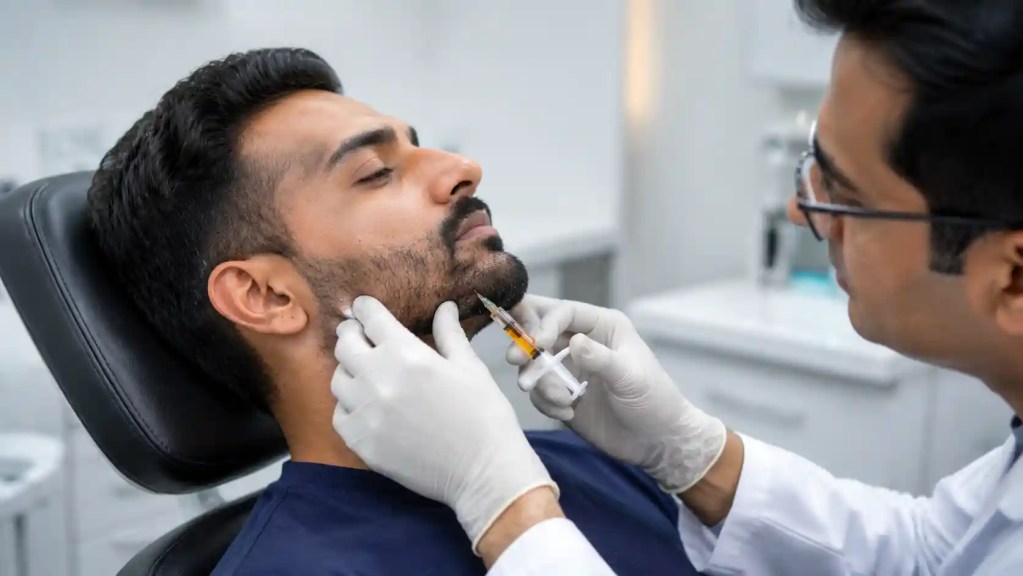
If you’re dealing with the autoimmune version, Alopecia Barbae, the approach is different. Specialists typically use localized corticosteroid injections directly in the bald patch. That calms the inflammation so the hair can safely regrow. Most guys see a real difference within three to six months.
If a patch has been completely bare since birth because of genetics, that’s usually permanent. The only fix is a micro-follicular beard transplant. Surgeons use the FUE method, taking healthy individual follicles from the back of your scalp or under your chin. They place these into the gaps, matching the exact angle and direction of your natural beard so it blends in. You can browse the International Society of Hair Restoration Surgery to see how modern graft placement works.
Frequently Asked Questions
Can a patchy beard fill in with age?
It really can, especially if you’re still in your early or mid-twenties. Hormone levels and facial hair density naturally keep evolving well past puberty. That said, if you’ve hit your thirties and the gaps are still there, it’s usually a different story. Genetics or dormant roots are probably at play.
Is beard hair loss permanent?
Not necessarily. It depends on what’s causing the drop-out. If an autoimmune flare-up like Alopecia Barbae or high stress is the cause, your follicles are usually just sleeping. They can typically be revived. It only becomes truly permanent if the hair roots are completely missing due to genetics or deep scarring.
How many PRP or GFC sessions does a patchy beard need?
Most guys generally need around four to six sessions, spaced roughly a month apart. That’s usually enough to see a real, noticeable shift in density. You might spot early baby hairs sooner. It usually takes a few months, though, for the growth cycle to fully reset and fill in the stubborn gaps.
Can stress really cause beard patches?
It can. When you’re going through serious psychological or physical burnout, cortisol spikes hard. That acts like a shock to the system. It forces a large chunk of your active, growing facial hair roots to shut down early and shed all at once. That’s what leaves behind distinct thin patches.
Finding the Right Path
Fixing a patchy beard takes time, and there’s no overnight fix. But getting a professional opinion early can save you a lot of frustration and stop the thinning before it gets worse.
If you’re navigating this in South Chennai, it might be worth dropping by a specialized place. Maynee Skin, Hair & Slimming Clinic in Velachery is one option. The skin and hair specialists there know exactly how the local hard water and coastal climate affect your skin. If you’re closer to one of their other locations, you’ll find their teams across Chennai in Porur, Nungambakkam, Ambattur, and OMR. They also have a branch in Madurai. Having an expert take a close look at your specific growth pattern can help you build a customized plan that actually fits your lifestyle. You can book an appointment through their booking page.